
Yesterday, I was racially profiled by the police in my neighborhood.

I was dressed in a dark blue shirt, rolled up at the sleeves and buttoned over an aztec print red crop top. I was wearing black leggings, navy blue and brown oxfords, and carried a mini backpack on my shoulders, just spacious enough to carry the new J.K. Rowling book, my wallet, and a few makeup essentials.

The only thing I hadn’t voluntarily put on was my brown skin color.

I arrived at the train station just a few minutes early in meeting a friend, whom I will refer to as Jen. I glanced at the the cops that were stationed in front of the other entrance of to the subway. The uptown six train had just stopped moments before, and masses of people were exiting the station. I was the only one there at the time not heading out or upstairs to a train. Through a gap in the crowd, I met the eyes of one policeman, who held my gaze briefly before tearing away to look at something else. I noticed that the others were determinedly avoiding looking at me.

I felt uneasy.

In the back of my mind, I already knew what was going to happen. Since I wasn’t going anywhere at that particular moment, it hadn’t happened yet. Jen arrived only five minutes later, although it felt like I was waiting a lifetime. By then, I had convinced myself that it wouldn’t happen, that I was being paranoid.

We strode towards the turnstiles only feet away, and I was in the middle of pulling out my Metrocard when it happened: a man clad in a navy blue police outfit unfolded his arms and approached me.

“Excuse me miss, we need to check your bag.”

My heart sank. I felt the heat rise up in my cheeks, humiliated. I followed the man to the check station, where I dumped my bag unceremoniously onto the table. I started to open it up, and the security stopped me.

“You don’t need to open your bag”, he said shortly. I pulled the rope that seals the bag shut, and he proceeded to rub some sort of cloth over the bag. I’m no expert in security checks but I have no idea how a piece of cloth identifies whether there is a homemade bomb or drugs concealed inside a small backpack or not. A few seconds later, I was free to go. The cops thanked me graciously and bid me a good day.

Fortunately, my sunglasses were able to hide the tears of fury and indignation that had sprung to my eyes. It had struck a nerve when they thanked me; I only snatched my bag back and stalked away.

I felt targeted. I was reeling with the injustice of what had just happened and the feeling of despair that there was nothing I could do about it.

Jen had been carrying a handbag much larger than my backpack. Although sharing part of the same ethnic background as myself, her eyes represented a nationality that set her apart from the targeted demographic.

Why do I believe that this was an act of racial profiling and not a “random” security check? Simple: this isn’t the first time I was stopped. On another occasion about two years earlier, I was in my train station accompanied by a friend who is Caucasian. He was wearing a large sized backpack, I was carrying a purse. The police happened to be randomly checking bags that day. Guess which of us was lucky enough to get searched?

As I am typing this out, I realize with a heavy heart how easily disregarded my story will be, simply because it isn’t a story. This is something that happens to people of specific backgrounds on such a regular basis that it has become the norm. It is widely accepted that this can and will happen; that is the ultimate tragedy here.

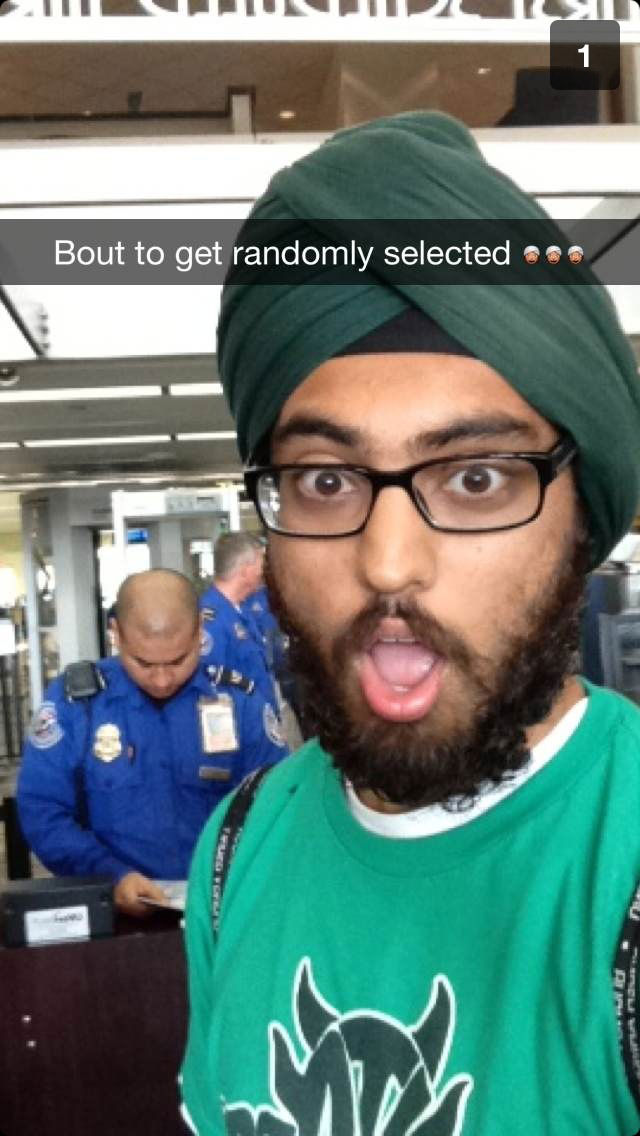
I was browsing the website Reddit the other day, and a photo that was on the front page caught my attention. Submitted into the subreddit “r/funny”, the photo in question was taken by a Sikh male heading into a security checkpoint at an airport. The photo in question:
Image

Highly amusing at a glance, but when you get to the core of the issue, it starts appearing less humorous. This is real life for many, many, many people.

A more serious example: Seema Jilani, a Muslim and American doctor, experienced blatant racism at our very own White House Correspondents Dinner. Jilani, a physician at Afghanistan married to a noted journalist, shares a story that sends across one message: it is become increasingly apparent that no matter your profession or social status, your level of patriotism or lack thereof, one can and will be identified by one factor and one factor only: whether or not you fall into a certain category that is doomed to be discriminated against forever.

My personal issue may seem infinitesimally small next to much larger problems occurring in the world, but it all starts from the beginning. These are mild examples of the ongoing issue of racism and discrimination in a country that exhibits much more deep seated events like this one.

Change is a word that is often thrown about by people, especially when they experience something shocking for the first time. What exactly is change? How can we make it happen? How can we make people understand the pain of being racially targeted, when millions of people just like myself will never experience what I did because they are a different skin color from me? How can I stop the tens of thousands of men and woman, young and old, from being stopped at the police station, frisked in the street, for no reason other than being who they are? How?

I initially intended to relay my story as calmly as possible, but it ended up turning into something of a rant, so I apologize that. But really, I am open to suggestions for change. Anything.

how society has turned the left wingers to the right.

INCOMPLETE****


This is my first time writing a version of an op-ed, but after viewing the multitudes of reactions on Facebook regarding a certain topic I have debated countless times in the past, I felt compelled to express my own feelings. I was flabbergasted by the general consensus of my peers regarding this subject, and therefore believe that my two cents on the matter is required.

Earlier this week, a news article released by NY1 stated that the NAACP Legal Defense Fund was filing a civil rights complaint against the city in regards to a long contested issue-the fact finding a needle in a haystack would be an easier task than finding a black or Hispanic student in any of the specialized high schools in New York City.

Stuyvesant, Bronx Science, and Brooklyn Technical High Schools are almost universally considered the jewels of the city. Nearly 30,000 students, with numbers steadily increasing yearly, take the Specialized High School Exam, or SHSAT, every October or November. I myself can easily recall the years I spent dashing to SHSI (the Specialized High School Institute) every Tuesday afternoon when school ended and waking up early Saturday mornings to attend the program, grueling over practice exams while secretly pining for the comfort of my bed. My parents even managed to find the means, like many other Bengali families, to pay for private tutoring at the infamous Khan’s Tutorial, where (at that time) a $70 a class fee was bartered in exchange for a teacher, who was usually a student at one of these specialized high schools, who drilled skills into our heads, the knowledge of which were mandatory in order to succeed in achieving a high score on the exam. The day came when I got my results; I was both anxious and fearful as I ripped apart the envelope that my guidance counselor handed me.

“Congratulations! You are being offered one of a small number of seats to one or more of the Specialized High Schools to which you applied and/or auditioned to.”

I had gotten into the Bronx High School of Science.

After a momentary celebration which involved jumping up and down and excitedly thrusting the paper to any teacher that cared to look, I was given a cell phone to inform my parents with. I called my dad, ecstatic, and told him the news.

His response: “Not Stuyvesant?”

The aforementioned SHSI

the future before my eyes.

Two weeks ago, the class was greeted by several UAlbany alumni who have progressed in the field that many of us in the class hope to enter, and succeeded. Ian Pickus, Katie Roberts, and Nick Reisman sat in a row at the front of the lecture room, smiles pasted onto their faces as the hordes of college freshman came into the classroom and proceeded to gawk at the guests. I was greatly interested in hearing what they had to say, mainly because these were young people who had achieved what I aspire to excel in one day.

Professor Bass introduced the three adults, and I leaned forward as the first person began to speak. Nick Reisman was part of the graduating class of 2007, a mere four years ago. He divulged information on his career, beginning with his participation in writing activities in high school, to gradually writing for the Albany Student Press when he got here. Writing for the ASP was one of the first goals I had upon entering the school as well, so I was relieved to hear that I was on the right track. However, his life took a turn when he realized that instead of print media, where he had spent time writing a local paper called Gazette, he yearned for the spotlight. He turned to television, and now works for Capital Tonight as a reporter. Reisman let us know that journalism skills come with time and experience, letting on that he developed a nose for interesting news after covering stories time after time; seeking a lead becomes almost instinctual.

My ears perked up when Katie Roberts informed us that she transferred from SUNY Albany to Syracuse University’s  Newhouse School of Communication; I had also applied to the school during my senior year, and did not get in-however, I had plans to reapply. She explained how she initially had a penchant for writing fictional stories, but later discovered that, after taking an intro to journalism course, that she was also fond of writing “real” stories, or news stories. By then I was sitting up so straight in my seat that my spine nearly cracked: this woman was voicing my own reality, for I preferred fiction writing as well. She voiced some of my main concerns, such as journalism becoming a dead career, but reassured us that online journalism was alive and kicking. Fortunately, I had been using the internet since I was six and blogging since ten, so the internet better be ready for the professional Tania.

Ian Picchus was on the quieter side, with a shy, boyish grin that didn’t match the loud writing style one needs to write the sports section of the paper that he engages in. His story involves growing up in the peaceful town of Saratoga Springs, which is nearby Albany, and pursuing both English and Journalism  degrees while studying at UAlbany. His interest in writing about sports initially began when he wrote for ASP, and later continued to do so, among other writings.

What fascinated me the most about these young pictures of success was precisely that-how young they were. They were only in their late twenties to early thirties, but had already reached high points in their careers. It raised my spirits a bit because these people were once just as normal a student as I am now, and gave hope to my somewhat irrational fears that I would not make it.

Before the class ended, the three young professionals gave us parting advice: Roberts told us to practice various types of writing, such as investigative and political; Picchus advised us to pay attention to government and politics, as citizens must be informed in order to avoid being deceived. Reisman had to leave early because duty called, but said to set aside time to write enterprise stories.

Far from being dull, as I had initially expected, the session with the graduates turned out to be informative and helpful, and I plan to utilize everything I learned.

OccupyWhy?

The OccupyWallStreet movement gained recognition in early September as common citizens, the bourgeoisie of today, protested the continued rise of income and greed that the wealthiest people in the country have come to enjoy. This one percent of the US is represented by corporate America, the epitome of which is found with the six hundred dollar suit-and-tie businessmen in Wall Street in the Lower East Side of NY. The other 99 percent represent the voice of the majority of America, who are fueled with anger by the lack of hand-outs given to them by the government, and abundance of said to the thriving one percent; their experience with the aftermath of all the reckless activities and trouble Wall Street businessmen had gotten themselves into over the years, only to be pulled out with their shoulders dusted off, while the less fortunate had to clean up the mess. Their rage has influenced people in many other regions, initiating an influx of Occupy movements in other regions, such as OccupyAlbany. The movements have also set off a domino effect in implementing other Occupy movements for various other causes.

The problem is that that particular one percent of America also happens to own the country, and therefore decides what information can be shared with the general public. The activists in Wall Street are standing up for those of us who suffer, but are also subject to false accusations, ridicule, humiliation, and misrepresentation. The sad truth is that most people believe the mainstream media conveys the truth, which is not the case. The only thing that can settle the dispute on whether or not the occupiers are in the right or wrong, or the one percent are actually not as villainous as they appear, are stone cold facts.

So what exactly are the facts? Let’s take a look at a recent New York Times article:

The total population of America is about 307 million.

The top .01% of the US make an average of about 31 million dollars a year-these include people like fashion designers [Ralph Lauren] and bank CEOs [Jamie Dimon of JP Morgan Chase]

The top .90$ average about 1.35 million dollars a year, by people such as Vikram Pandit, of Citigroup-yet another banking company.

The top ten percent of the country average about $167,000 yearly-such people are Jay H. Walder, formerly of the MTA, and Raymond Kelly, NYPD police commissioner, who makes over two hundred grand a year.

What does that leave? The bottom ninety percent. Important careers such as school teachers, police officers, sanitation workers-their annual salaries average only $36,000 a year.

These are facts.

Sure, the protestors on Wall Street may have stretched the truth-they present the 90 percent after all, instead of the 99 percent. That still leaves 276,300,000 Americans to be accounted for.

In Wall Street’s defense, they make a good point in that during their golden era, everyone can rejoice. When the business was booming, they claim everyone profited: “we left 35 percent tips at our business dinners.” Representatives say that they run the market, and while it flourished, the economy thrived, but the second it crashes, the government runs around looking for a scapegoat, and its’ eye lands on Wall Street-as do the eyes of the rest of the country. They work their behinds off with no breaks, no pensions, no unions, yet the people disregard all that, the so-called common people with their four month breaks, pensions at the age of fifty, 9-5 jobs.

However, in a rush to victimize themselves, they neglect to mention the benefits they reap from all their hard work. In addition to making big bucks, they save a lot too: for instance, it was discovered that General Electric avoided paying taxes in the last year, and in fact gained a 3.2 BILLION dollar tax benefit.

I feel I am not alone when I say that many of the ninety percent would give up their unions and pensions any day for that kind of benefit.

In a bizarre scenario, let us say that the Occupiers were actually wrong, and they were in fact behaving like angry little kids who had their toys taken away. If we reap the benefits while the top ten percent thrive, where are our benefits now? The economy did collapse, but according to your salaries, it seems like it was simply a bump in the road. Meanwhile, the unemployment rate continues to decline, and the average salary in the US decreased by nearly two percent.

Corporations shall prosper at the fate of the common people. We are merely the cogs in an ever running engine controlled by the rich and powerful.

A blogger’s review of a blogger.

I recently read Rosemary Armao’s blog on the Times Union website. Her writing proves to be opinionated and straightforward, a rather refreshing take on things.  One of her blogs caught my eye: it was a review of her recent high school reunion. She posed many interesting sentiments, such as the success of the class victim, the everlasting beauty of the girl that stole everyone’s heart, the lack of diversity in her old class. She comments on how remarkably easy Facebook made it for planning the event, and recovering all her long lost classmates.  Armao mentions at some point when she recalls the group arguing, that “We remain, after all, children of the 60s and 70s, individualistic and hard to reign in.” It struck me as an interestingly proud statement and made me wonder: would my graduating class and I reflect traits only visible in teens of the 21st century? What in particular would stand out, besides the advances in technology? Sadly, I feel as if the kids from the past have covered all the grounds in change and individuality-all we are doing is bringing back the past.

Another sentence in her blog stood out to me that isn’t particularly relevant, but I found amusing anyway: “I enlisted my mom, the Reunion Queen, to help cook and organize. Reunion Day began with her running in from the backyard about 8:30 with a panicky edge to her voice: “Ro, Ro, who is this in my driveway?” Outside, walking in from the street where a yellow taxi was parked we found a middle-aged, long-haired woman in a sari. She could have been a classmate — except she wasn’t.” I was a little confused as to why her mother would be panicked, but moreover, I absolutely cannot understand a world without diversity. Living in NYC all my life has spoiled me, and all I know is a world with different people and different things and lives and places and everything. No one in NYC would panic at the sight of an old Indian woman on their front stoop. They would be more likely to ask if she would like some tea.

At any rate, Rosemary’s blog intrigues me, as does her expansive knowledge of almost everything, so I have officially bookmarked her page on my web browser.

Bengali Fairs.

The tangy aroma of sizzling shish kebabs, delicious chicken curry, freshly made mango lassi, and chestnuts roasting on an open fire (just kidding about that last) filled my slowly dilating nostrils as I finally discovered the crowded street where the mela was being held this week. Most people look forward to beach activities and things of that sort when the summer draws nearer, but Bengali residents in New York City share another joy: melas, or Bengali cultural fairs, that take place throughout the boroughs for as long as the sun beams, glowing upon and warming our naturally tanned skins. For some, the excitement lies in the large gathering and celebrations of our minority group, although the latter term has been questionable over the years as our population grew in our fair city. For others, like myself, joining in the events are our guilty pleasures, especially that of the modern Americanized South Asians.

I had not experienced a mela in recent years due to the gradual distance that I maintained between myself and my heritage. After outgrowing my rebellious teen years, I decided that it would be best to return to my roots, and where better to start than a mela? I nostalgically remembered past summers where, upon receiving word of an upcoming mela, my friends and I would chatter nonstop about the event that would likely complete our entire summer. It always did.

Now a self-declared “wise” young adult, I wondered what exactly about melas I once found alluring; filled to the brim with conservative Bangladeshis, especially the older generations, we would not even be able to enter in our normal clothes without being scowled at, and god forbid we try to arrive with a member of the opposite sex who isn’t our father-the rumor mill begins. There would always be some sort of drama going on at these fairs, because wherever there is Bengali people, drama will follow. However, the thought of mouth-watering Indian food was tempting, and so I sought one out. I convinced my childhood friends to accompany me for old time’s sake.

This particular mela was held in late August in the Jackson Heights part of Queens, also known as Little Bangladesh. This was because the neighborhood was overpopulated with Bengali families, stores, tutoring centers, meat markets and such. They usually begin late in the morning, and continue on into the evening. Of course, we arrived fashionably late. I’m not quite sure how we were unable to find it to begin with, considering the decibels at which the foreign music was blaring, but we did eventually. Once beyond the road blocks, I spotted a stand selling polaow and chicken masala-I made a beeline for it. After buying an overpriced plateful, my friends and I wandered down the street, occasionally greeting a familiar face here and there. It occurred to me that that was one of the perks of melas for us: we ran into friends, more often old ones who we hadn’t seen in a while, which was always a thrill. Nowadays however, with online social networks, it made it easier to keep in touch with these old friends, and wore away the excitement of seeing a familiar face.

There was a crowd forming at the stage set at the end of the street. There were planned dance performances, Bengali singers, and speeches to be made throughout the day. We stayed long enough to watch a friend of mine, who is a member of a popular [among the Bengali community] dance group perform, and an elderly woman serenade the audience in a rather wobbly voice. It wasn’t exactly impressive, and the crowd gave very little feedback-I guess no one told them about the “clap when the performance ends” rule; common courtesy people.

In the next couple of hours, we amused ourselves by pausing at every stand that lined the streets, talking to strangers, avoiding Bengali mothers staring at us, and buying more food. I was saddened that something that once brought me so much joy and excitement now bored me. I was too young to have become jaded, so I believe that it wasn’t that melas now lacked the fun that it was once known for-this particular mela was simply poorly planned. We never had to end up finding entertainment for ourselves in the past-entertainment came to the people.

In hindsight, I suppose I did bear a sort of cynical view of melas upon my last experience, and this may have influenced the mediocrity that I felt.

the wonders of worldstarhiphop.com

The internet reminds me of my old high school. It’s a strange metaphor, but just as the students at my alma mater were known for their eccentric personalities yet obvious intelligence, so is the internet and the websites that are a part of it. It has the weirdest websites that actually ooze with public influence.

World Star Hip-Hop is one of the oddities in this world that fascinates me. It combines the rawness and reality of life itself, with the audience of the internet. It is, if you will, a type of journalism; moderators apparently hunt for things like video clips taken by anyone that will pique the public’s interest, such as a fight on the subway, a brutal police beating, provocative singer on The X Factor, etc. It also helps to promote up and coming rap, hip hop, and r&b artists. Once a URL known only to the underground folks, or avid web surfers, it is now a worldwide sensation, with videos reaching millions of hits daily. I am convinced that its’ audience varies widely based on the different people on my Facebook friends list who admit to watching much of the vulgar videos it provides, from Harvard undergrads to high school drop outs, nerdy east asians and hood rat south asians alike

Example A: a young man teaching his grandfather how to dougie, a popular song/dance invented by hip hop group Cali Swag District

Example B: A rapper who most likely “knows politics

Example C: You wouldn’t understand the above reference if you hadn’t watched this on worldstar

Steve Jobs passed away this week, and of course he will be sorely missed. There is a lot of talk about how we lost the greatest innovator of our time, but I highly doubt poverty struck families in Bangladesh and the Philippines are aware of this. Who wants the iPhone 4Gs, when you cannot even get clean, safe water to drink every day? Innovation covers a lot of ground, and I feel as if the mods of World Star Hip-Hop should be acknowledged, because their job involves a novel type of journalism that surpasses even YouTube, in the sense that it entertains, informs, and presents new things, unlike the latter website that has no filter.

Interview with the Roommate

Tania Rahman

AJRL 100

Interview: Errors in Judgment

When I first laid eyes on Sofeia, I was both pleased and disappointed to see that she seemed normal. Upon discovering my roommate-to-be’s name during the summer, I immediately hunted through Facebook to find her. After we messaged back and forth a bit, I was a bit hesitant that I would get along with a girl who grew up in a town that had a population of 1,418; my high school’s population itself was twice that. Our conversation appeared slightly strained-we both spoke with totally different dialects, my typing embedded with internet lingo, and hers perfectly punctuated and grammatically correct. But NYC residents are known for their liberal views and open-mindedness, and I decided to give this country girl a chance, although I had still hoped she would at least come through the door looking like she had just milked the family cow.

Fast forward four weeks-we got along like two peas in a pod. I was shocked that two people who were so strikingly different could get along this well. I wanted to know more about how someone could spend their entire lives in a place that was not the city.

I woke her up around 1 AM, as she was on the brink of a deep sleep. “Hey, have you ever ridden a cow to school?”

She blinked up at me. “Um, no.”

“Alright well get up farm girl, I have some questions for you. “

Despite being shaken awake in a not-so-pleasant manner, she sat up on her lofted bed and smiled deviously down at me. We bickered often about city life versus country life, and she was convinced that the country was better. I was determined to break that mindset, city girl that I am.

Sofeia started off with an interesting tidbit-her parents were actually from the city, her father having grown up in the Bronx, my hometown. Her mother, a Brooklyn native, had teamed up with her husband after they both agreed that city life was too dangerous to raise a family, and moved to Smyrna New York.

I interrupted. “Did you say Smirnoff? Like the alcoholic beverage?”

She smiled patiently; apparently only the immature high school kids still called it that.

Growing up with two older sisters, she was the baby of the family, and therefore coddled to the point where she was unable to do many things, such as date or even take a run on her own. “Actually, now that I think about it, it wasn’t too bad”, she recanted. “You have to understand that my parents had very bad experiences when they lived in New York City, and it’s probably the reason they’re so overprotective.”

Apparently, she did not live on a farm. “I did raise chickens once though, but they were free range chickens”, she informed me. What were free range chickens? I plowed on with other questions, delving into personal territory.

“When did you meet your boyfriend?” A smile played on her lips as she we touched upon her favorite subject. She and her group of friends had been together since the first grade, and Dan was merely another kid who lived in town, not of much importance. It wasn’t until the eighth grade that she was captured by his green-eyed gaze, and by freshman year of high school they were dating.

“At first, I felt a little guilty about lying to my parents, to be honest”, she admitted. “It didn’t really matter because we weren’t doing anything; I mean I was still going home after school every day. But it’s not like I could call him whenever I wanted without telling them that I was in a relationship. But they pretty much confronted me, like ‘Sofeia, we know you’re dating Daniel. So that was a relief.”

The wall beneath her lofted bed was plastered with pictures, proof of long lasting relationships with family, friends, and boyfriend.

She glared at me as I typed. “You haven’t asked me a question in a couple of minutes; are you trying to make me out as a cow-riding, chaw spitting farm girl?”

Was I doing that? Naw.  Wait, what’s chaw?

I asked her how her adjustment to the city of Albany was going. “Did you experience culture shock?”

Strangely, she didn’t. As one of the few minorities living in town, she was often subject to racist comments from the kids at school, most of whom were unused to people who were not white. “I enjoy being in a diverse community now; it’s a cool experience and I like being among people from various backgrounds. But I love where I was raised.”

“Now that you’ve experienced both ends of the spectrum, do you still prefer the country?”

She paused. “That’s a difficult question. In the country, there’s so much to marvel at, like the trees, the leaves changing colors, the animals, and the solitude. But I also enjoy things about the city, like the diversity…I don’t know. The business is kind of cool. I think the city looks pretty at night, with all the lights. I haven’t experienced enough to really get a grasp of it, but city life makes me appreciate country life.”

She told me that she did not and would not ever try alcohol or drugs of any kind, and she was opposed to parties, or at least the school’s idea of it. “So with that mindset, why’d you decide to come to SUNY Albany? We have a reputation for that stuff, you know.”

“I came to Albany for the school”, she said scornfully. “I liked the setting and everything; I didn’t come here for the parties. I wanted to come here for other reasons.”

Finally, I asked her the most important question of all: “What do you think of me as a roommate?”

“Hmm…I think you are..” She stopped. “I think because we were raised differently and had different childhoods, we have different experiences, and I feel like your experiences have enlightened me about things, which I enjoy. But at the same time-okay I don’t know where I was going with that.

I laughed, and we both went back to sleep.